
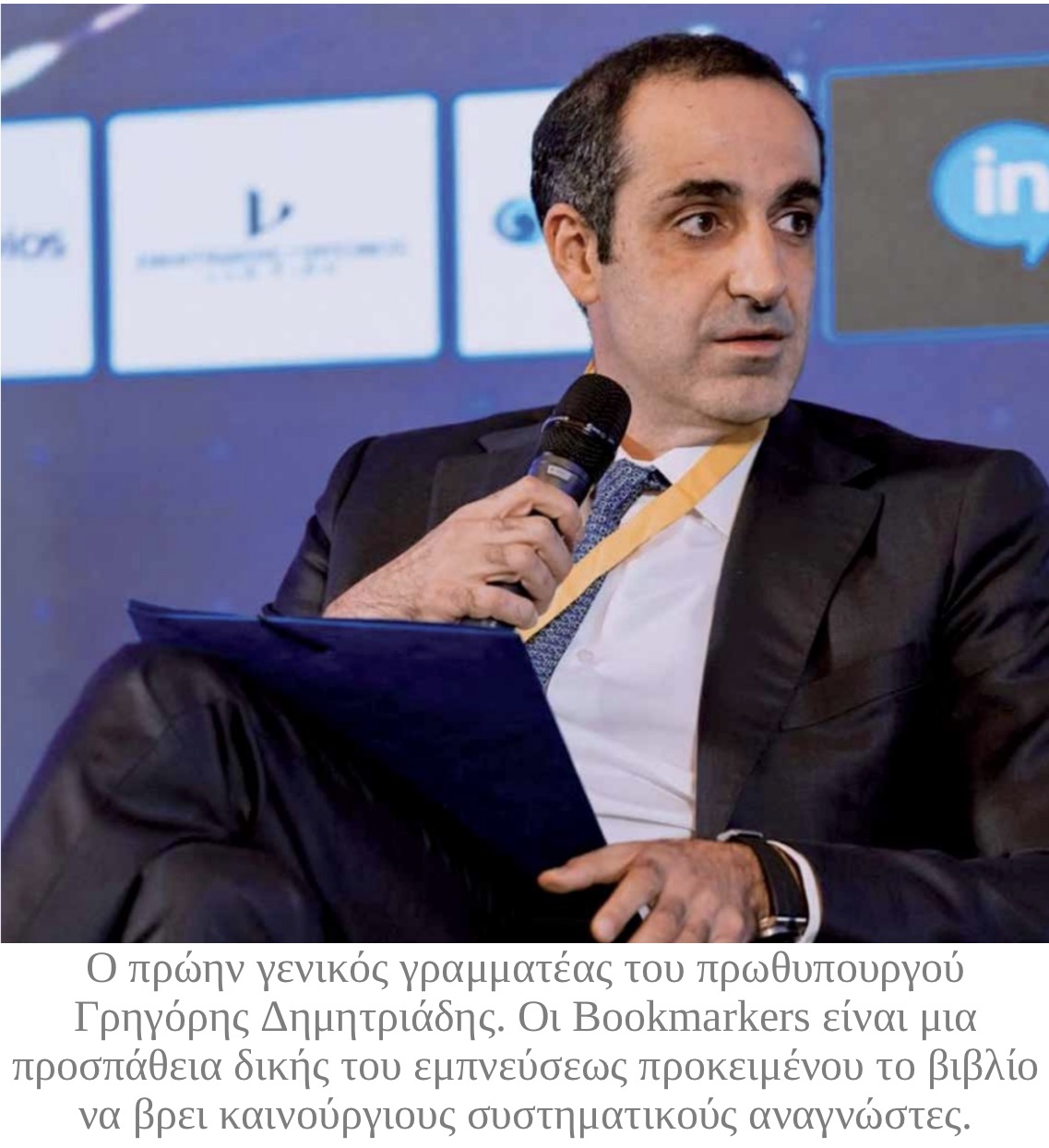
Grigoris Dimitriadis on the need to disseminate the book and the Bookmarkers
A few weeks ago, a new move centered on the book was presented at the Bookloft bookstore a new move focusing on the book and the need for its dissemination: the Bookmarkers. A citizens' initiative with ambition to strengthen the relationship with the book more and more Greeks. Bookmarkers aspire to contribute to the dissemination of books in everyday life and, of course, reading, through activity that will be specialized in the coming period. The aim, as its pioneers say, to create more readers, to create many active communities of readers throughout Greece.
Initiator of this initiative, a person who has engaged in many ways the political life of Greece – Grigoris Dimitriadis, who from 2019 to 2022 served as Secretary General of Prime Minister Kyriakos Mitsotakis. A person with a strong presence in public things, who often talks about his passion for books and reading, argues that beyond political passions, the country must cover its basic deficit, the relationship between citizens and knowledge. And one way to do it is to have a relationship with books.
What can it mean to mobilise a conflict policy for the dissemination of the book? And what will they bear, what are the Bookmarkers able to bring into a foreground in which the book, especially the good book, is the subject of interest in small portions of initiates?We met Grigoris Dimitriadis and had the conversation that follows:
Bookmarkers were born of the desire to bring more people near the book. Do you think the relationship between modern Greeks and reading is flawed?
The answer is that we wrong the Greeks. I'll give you an example. I was recently at the Book Fair in the field of Mars and what impressed me was not only the big turnout. I figured out two things. First of all, I saw a lot of youth participation. The second thing I saw was that the questions they asked in the kiosks were very targeted. They asked specialized questions even about who made the translation into the book. I mean, they seemed like people who read, familiar with the book. These are encouraging signs that you don't get past.
Do you want to combine the reading deficit with the state of Greek education, as is regularly highlighted in Pisa's competitions? What we call philanthropy requires understanding, critical reading, deepening? Or is it just fashion for a limited audience?
It's not that simple. Despite the adversities, we do not easily get through the crucial chapters of reading and education. Let's redefine what fashion is. I'm gonna go against the current a little bit. Why should the expansion of the book’s public not be fashionable? Is there yeast? Is there a basis for this? Of course it is. So the connection to the book is not just fashion; it is something more permanent. I don't know many who love the book and stop reading. So I'd say reading is a way of life.
You have said that there is no day in your life that you do not open a book. What is reading to you? A way of knowing, a form of escape or something deeper, a process of understanding ourselves and the world surrounding us?
They're all together. Let me point out the basic: when you read, you always discuss the author and you. This communication has a philosophical background, which is so lacking nowadays. And also reading offers you the pleasure of slowness. As far as I'm concerned, it helps me to slow down my rhythms, to activate my thinking, to lead her on paths of pleasure. Because reading at the end of the day is a pleasure. It is a kind of addiction, but it obeys the rules of reason. As far as I'm concerned, I can't help but open a book in the day.
We live in a strange time: we probably read more words than ever, but in small quotes, with constant distractions and with great speed. What is lost when the possibility of slow, concentrated reading is lost?
First of all, pleasure. Second, the difference between the book, unlike the little texts and passages, is that you start reading something with beginning, middle and end. So you're starting a whole trip. The book, after all, accompanies you.
The book obliges us to stay for a long time in the thought and the way writers express themselves – even when we disagree with them. In an era of intense polarization and certainty, can reading also function as an exercise of understanding of the other?
But is there a better way to combat polarization, certainties, but also conspiracy theories from reading and studying?Reading, as I told you, is not a solitary act, is a ritual of dialogue primarily with the author but also communication with the public. A book, read by many, is a basis for meaningful dialogue even when we have a different approach, appreciation or view of a book. The book is the appropriate treatment against polarization, doctrines, and certainties.
We often feel almost self-evident that reading makes man better. History, of course, does not always confirm it. What can the book really offer to the reader, and what would it be too much to attribute to him?
Since you refer to history, what better example than Germany?Where Goethe was great, or – to go to the troubled interwar era – where Thomas Mann, Bertolt Brecht, Erich Maria Remark, Alfred Deblin and Stefan Tsweich put their seal on world literature, that is where we had the rise of Nazism with Hitler and the burning of books in the fire. At first it seems contradictory, but I would like to point out that even in the dark days there were Germans who resisted, even passively. Hans Fallada's masterpiece, Alone in Berlin, highlights a side not particularly enlightened by History. It is the story of a couple losing their son on the front and, after his death, sets out to overthrow the German propaganda mechanism, distributing notices against Hitler. But today are these writers who have spent eternity? And why not think backwards? What if there were not all these great writers? In the reconstruction of Germany, after World War II, did the intellectuals not contribute? For example, Guder Grass's tin drum, which adorns the barbarities of Nazism, did it not help to self-criticize and cleanse an entire people?
You are talking about creating a 'active reader community'. But reading is a most important act of loneliness. What does it mean for you to turn this private experience into common, public experience?
Reading, of course, is a lonely act. But this is the starting point. But sharing books, discussing them, exchanging ideas is not lonely at all and is very nice. As well as it is not lonely to meet heroes in distant times, in difficult situations, in love, in mourning and in general throughout the spectrum of human emotions.
There is already a whole world around the book – there are publishers, bookstores, libraries, publications, festivals, reading clubs. What is missing from this ecosystem? What exactly gap do Bookmarkers aspire to fill?
The ecosystem's fine! It's full. But like the universe, it tends to grow. What to do, we're lovers of evolution and development. We also have the taste of reading, we love the book, we feel the threats to be cornered by the digital charge – so I think every effort to support the ecosystem, as you describe it, is welcome. That's why the Bookmarkers were created.
How can one take the book out of the circle of inspired readers without at the same time demeaning it to become "attractive"?
The method is no different than how I convinced my son to read and – mainly – love the book. Don't tell me my son and every child were born a initiated reader! And yet, he learned to love the book, end it, look for the next one.
What exactly do Bookmarkers expect? What goals do they set? And how will they measure their success or failure?
Reading from end to end, supporting authors and independent bookstores and offering books where necessary. And above all, undivided love for the book. And if we've won some, at least, readers after some years, it'll be a profit for us. That's enough. We're not going to change the planet, we know our limits. But the effort is worth it.
You have known very closely the politics and the exercise of power. The book, on the contrary, has no power in the immediate sense; its effect is complex and certainly not measurable. Through your experience in politics, which has even made you unpopular in part of society, and by your relationship with the book you describe it deeply and meaningfully, what do you think changes a society deeper: the authority that can decide or ideas that can change the way people think?
A man who thinks, who widens his horizons is able to make better decisions. Power becomes more democratic if exercised by people who think. In my opinion, moments of reflection play a major role. Reducing the rhythms of everyday life, which are often exterminate, seeing the big picture, delimiting the beginning, the middle and the end in managing a problem. So you avoid falling into the trap of the short term, which in my opinion is the scourge of the time. Instead of having a head over water, the politician should aim at medium and long-term.
What would you answer the question, is your involvement with the book a systematic attempt to groom your public image?
I was reading before I got a public image and I'm gonna read to the end of my life. There is therefore no question of grooming or not grooming. What I'm trying to do is convey my love for the book. I think a citizen, in the finale, can separate everything else from it. And ultimately, there's no need for miserable criticism of everything.
And something personal: what five books you've read would you read again?
It's a tough choice. However, I would stand out to myself Mark Aurelius, the Book of Concern of Fernando Pesoa, the poetic mosaic of Miltos Sachtouris, the Ungoverned States, the trilogy of the Military Circus, and all, but all the books of Giorgos Skabardonis.
Interview with Natasha Paschali. Source: The Books’ Journal — https://booksjournal.gr/blog/6386-as-apodosoume-sto-vivlio-tis-times-pou-tou-anikoun